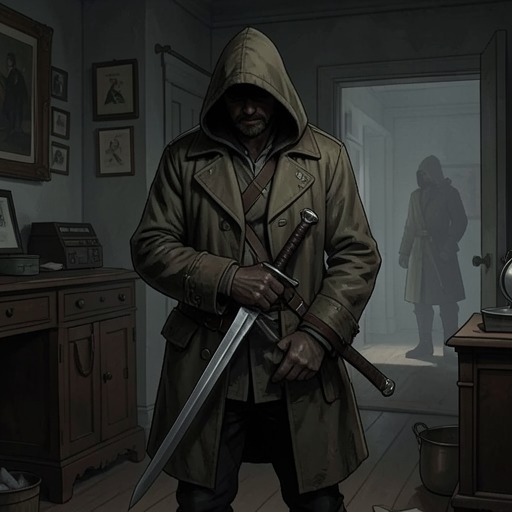
Thobela Mpayipheli’s first assassination in Munich
Heart of the HunterThobela Mpayipheli’s first assassination in Munich is recalled as both a killing carried out under orders and the moment he recognized that the method itself violated his sense of honour. A trained sharpshooter, he takes aim at the West German double agent Klemperer, but the appearance of a woman and child interrupts his shot. When Klemperer later emerges alone, Thobela fires; afterward, he concludes that he cannot wage war from concealment, without giving an enemy the chance to face him. The episode returns years later as a memory he hopes to put behind him, linking his earlier life as a weapon to his attempt at change.
The memory and its background
The assassination is not introduced as a continuous account of the Munich operation. It rises into Thobela’s consciousness during a later journey: after feeling tense at a petrol station, he rides through the growing dark, his attention divided between the road and the memory of his first killing. The fall he suffered in a Karoo storm still affects him, but the older experience occupies much of his thought. He allows the memories of the preceding day to return, wondering whether reliving them might be part of healing, change, or closure. The remembered event therefore carries two kinds of pressure: the immediate danger of the mission as he experienced it then, and the question of what that past means to him now.
His competence as a marksman had been established before the assassination. In East Germany, while studying at the Stasi sharpshooters school, he and the other students helped test an experimental SVDS. Evgeniy Fedorovich Dragunov, the Russian weapons developer, took a particular interest in Thobela’s accuracy. In poor light and a crosswind of seventeen kilometres per hour, Thobela achieved a grouping of less than 400 millimetres at 2,000 metres. That record makes the Munich operation an extension of a skill he had already demonstrated under extraordinary conditions; it does not make the first real killing feel like a practice exercise.
The target and the first hesitation
In Munich, Thobela holds an SVD, described as the latest model, with a synthetic, non-folding stock and a deadly reach of 3,800 metres. Klemperer, a bald, middle-aged West German, is expected to come through a door roughly a kilometre away. He is a double agent feeding both sides, and the KGB has marked him for elimination. Thobela, an African National Congress exchange student, understands the assignment as a demand to prove his worth. He even wants to dedicate the shot to Dragunov, whose attention had affirmed his ability as a student.
That professional frame breaks down when the door opens and a woman and child appear in the scope. Thobela’s finger is already on the trigger; the sight rests on the woman, but he does not fire. The presence of civilians stops the action at the critical instant. The contrast is explicit in his recollection: competition on a practice range had involved the intensity of sport, while the Munich target is a living person. His skill has carried him to the threshold of the act, but it cannot settle whether he can accept what the act requires.
The killing and its immediate consequence
Thobela wipes the scope lens, checks his focus and adjustments, and waits for the door again. During the pause, his response changes from concentration to distaste. He recognizes that this is not the way he believes war should be waged, or the way his people should fight. Yet when the door opens and Klemperer appears, he fires. The shot kills the target. The action is presented without turning the killing into a triumph: the significant consequence is Thobela’s judgment of it, not the technical success of the shot.
He dismantles the rifle and packs it away in forty-seven seconds. That brief, practical aftermath closes the operation but not its moral effect. Thobela decides that he cannot continue to wage war in this manner because there is no honour in it. His conclusion is not simply a rejection of marksmanship or of combat altogether. He sets out a standard for combat in which the enemy must be visible and able to fight back. The distant, one-sided shot becomes the example against which he defines that standard.
Return, change, and significance
When the memory returns on the road, Thobela does not treat it as settled history. He lets it run through his mind, considering the possibility that remembering may help him achieve closure and move beyond the person he was. That later perspective gives the Munich scene a place in a larger change of identity: the event shows the first clear limit he sets on his own use of violence, while the act he completed remains part of the past he must confront.
The episode’s central tension lies between effectiveness and honour. Thobela possesses exceptional technical ability, and the mission’s demand fits the role for which he has been trained. But the woman and child expose the human stakes that precision cannot remove; his initial restraint and subsequent shot leave him with a lasting rejection of assassination at a distance. His rule that an enemy must be able to see and fight back makes the scene a formative memory, not because it erases his participation, but because it gives him a principle by which to judge it. In the later recollection, that principle becomes part of the change he is trying to complete: the first killing returns as evidence of what he did and as the point from which he understands what he can no longer accept.